Age Verification
This website contains age-restricted material including nudity and explicit content. By entering, you confirm being at least 18 years old or the age of majority in the jurisdiction you are accessing the website from.
I am 18+ or older - Enter
I am under 18 - Exit
Our parental controls page explains how you can easily block access to this site.

Derniers messages - Page 1580

  Forum

x2463378
Inscrit en Aug 2008
148 message(s)

Finally Done!! Models By Country

Tout sur iStripper
12 March 2017, 42 réponses
@mo7ibelkuss

OMG! 3300 cards? I couldn't put in that much time. My first attempt on my Mac in AppleScript created two Excel spreadsheets. One has a line of data for each card including counts of clips by type. The second has one line for each clip. The Access DB stores its information is half a dozen tables and can output various summaries or full details.

@dorsai6:

I did not go by cards, I went by girls/models, not cards, so my spreadsheet contains 752 rows of girls/models, Not 3300 rows of cards. Then for each girl: I counted the number of cards that each model performed in each card category.

The information was easily obtainable from the website, not the software, which has 18 web pages of girl names (with each page containing 30 girls) and the stats of each one of them, and if you click on the girl page, you can see all her cards. So I went through each girl/model in the website, and manually input her data, and counted her cards in each card category.

Of course, I had to go to the software to collect the info for the models in the classic collection, but that involved 259 cards only, and even there, I went by girl names not cards.

I admit it was tedious, and after I was done I spent many hours reviewing that data and insuring its accuracy, and running multiple audits, but it was necessary for me to obtain accurate info. I have no programming background, so any discussion of me attempting to use technological tools to achieve this was not possible based on my poor skills in programming and and my poor understanding of the inner workings of the software :)
TheEmu
Inscrit en Jul 2012
7424 message(s)

Finally Done!! Models By Country

Tout sur iStripper
12 March 2017, 42 réponses
@mo7ibelkuss

I am impressed that you put in the effort to do the analysis, but there are easier ways to do it than manualy entering the data.

Dorsai6's approach of converting the whole of the iStripper card and model data into a standard databse is the most flexible way of doing such thing but requires programming skill to produce the database in the first place.

A simpler, quick and dirty, method is to install Agent Ransack (a free file search utility) and use it to seach the xml files in your vghd/data directory. Specify ?????.xml to seach just the xml files for each card and ignore any others, specify <country> as the text to search for. After about 50 seconds it will display a list of the files it has found. Click on Reports, select "Contents" rather than "File List" and you will see a list of lines each looking like

a0001.xml C:\Users\X-Format\AppData\Local\vghd\data\a0001\ 04/05/2016 07:09:32 2 40 <country>France</country>

with two such lines for a duo card. You can of course search for any text, but for the iStripper files its usualy best to search for xml tags to avoid matches to words in the models descriptions.

The report can be exported as a text file or a CSV (comma separated values) file which can then be loaded into a spreadsheet. You can build up a more complete database by merging the results of multiple searches.

Any spreadsheet you produce this way will not be as useful as Dorai6's database, but it requires little skill to produce it. Agent Ransack (or an equivalent program) is a useful general purpose tool to have on your computer anyway. Don't be disturbed by the name - its the free version of a comercial "professional" file search tool.
Dorsai6
Inscrit en Apr 2013
3465 message(s)

VG on a 1440p Screen

Tout sur iStripper
12 March 2017, 17 réponses
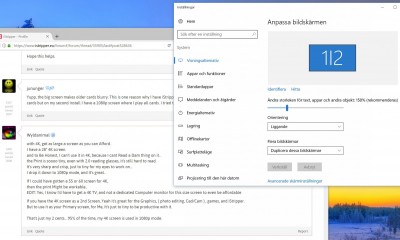
I have 3 displays running on a 2013 Mac Pro. I don't do much gaming, so 60 Hz is fine for me. My main display is a 40" 4K Phillips BDM4065 (3840 X 2160). It's about 2 years old now. My second display is a 30" HP LP3065 (2560 X 1600). It's about 6 years old and was my main display before I got the 4K. My third display is a 23" HP LV2311 (1920 x 1080). It's about 4 years old and replaced a smaller display the failed.

All three of my displays have about the same number of pixels per inch so images have about equal crispness. If you had a smaller 4K display, images would look sharper because of more pixels per inch. My wife really likes her 27" retina iMac for just that reason. It's a 5K display in just 27", effectively twice the pixels per inch.

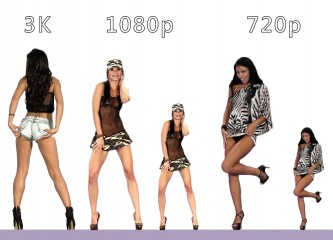
I've done a lot of experimenting with iStripper on all three displays. When you display a card larger than it's nominal size you get some blurring and pixelation. The more you enlarge the card the worse it gets. I normally play cards at 60% on my 4K display. The 3K cards look great and the 1080p cards are a bit blurry, but acceptable. As a point of reference a 3K card at 45% on the 4K display is at it's nominal resolution. Anything larger is being scaled up. When I play 720p cards I only play them at 30% because to me they look terrible at 60%.

On a 1440 display a size of about 65% will produce nominal resolution for a 3K card.

I once did some experiments with my 4K display in portrait mode. The 3K cards were a little fuzzy at 80% but the size was awesome. The 1080p cards were ***** at 80%.

The net result of my experiments is that I seldom watch 720p cards. When I do it's in small mode. The old 480 cards are even worse. When I watch them its at about 20% - ten tiny girls.

On my Mac, iStripper seems to calculate image size based on the size of my main display regardless of which display is showing the card. When I ***** a card from one display to another, there is no apparent change in size. Remember that the pixels per inch of all three of my displays are about the same.

Hope this helps.
IceCold007
Inscrit en Dec 2008
250 message(s)
stefnev1
MODÉRATEUR
Inscrit en Jul 2008
17583 message(s)
stefnev1
MODÉRATEUR
Inscrit en Jul 2008
17583 message(s)
stefnev1
MODÉRATEUR
Inscrit en Jul 2008
17583 message(s)
TheEmu
Inscrit en Jul 2012
7424 message(s)

Dancers' ages?

Tout sur iStripper
11 March 2017, 13 réponses
@Number6 - I agree with you about Ava Courcelles, Its odd that no age appears when looking at her cards because its in the xml files, all seven of them give her age as 33 as you had deduced.

Here are the cards which, according to their xml files, have performers aged 31 to 34. Again I have left out the VirtualGirl Classic cards for which the ages are suspect. I also have not yet downloaded the latest 62 cards (because of the network connection I am currently using) so there might be a few in those as well.

Age 34
d0040, d0050, d0076, d0058, d0192,
d0204, d0208, d0239, d0289

Age 33

a1401, a1402, a1403, a1404, a1405, a1406,
d0038, d0041, d0065, d0103, d0111, d0116,
d0117, d0119, d0123, d0128, d0151, d0157,
d0168, d0187, d0189, d0209, d0221, d0226,
d0238, d0241, d0264, d0274, d0286,
e0014, e0015, e0016,
e0611, e0612, e0613,
f0027, f0028,
f0030, f0031

Age 32

a0521, a0522, a0523, a0524, a0525, a0526,
a1319, a1318, a1320, a1321, a1322, a1322,
a1500, a1501, a1502, a1503, a1504,
d0010, d0035, d0042, d0054, d0089,
d0092, d0093, d0099, d0110, d0139,
d0166, d0170, d0175, d0180, d0186,
d0198, d0205, d0211, d0217, d0222,
d0231, d0228, d0248,
f0013, f0014,
f0016, f0017

Age 31

a0479, a0480, a0481,
a1115, a1116, a1117,
a1118, a1119, a1120,
d0008, d0027, d0039, d0046, d0049,
d0059, d0062, d0064, d0069, d0075,
d0080, d0086, d0088, d0091,
d0095, d0097, d0098, d0106,
d0124, d0127, d0132, d0135, d0137,
d0143, d0159, d0163, d0164, d0165,
d0169, d0181, d0190, d0195, d0196,
d0207, d0212, d0216, d0223, d0235,
d0255, d0299,
e0470, e0471, e0472, e0473,
e0554, e0555, e0556,
e0592, e0593, e0594, e0595,
f0171, f0172, f0173

TheEmu
Inscrit en Jul 2012
7424 message(s)

Discussions for Scenes for Version 1.2.X Fullscreen Mode here

Tout sur iStripper
11 March 2017, 5111 réponses
@DrDoom9 - The black water is, presumably, because gl_Color is comming through as all zeros which will multiply all the coulr compontents by zero resultng in a transparent black area. I thought the default was all ones which leaves things unchanged but on thinking it over the rule must be a bit more complex. Add a

color : 1, 1, 1

to the clip sprite as well as uncommenting the opacity : 0,5 clause.

Reflections or shadows of frontTable clips are a problem because the legs, and sometimes more, in the original clip are often below its built in "hotspot" so when you invert them the reflections are above the hotspot making them stick up in the air and shadows are offset if you have applied any rotations.
It is possible to mask them, but can be tricky depending on the scene. To use a simple mask you need one that is opaque above where the performer is sitting and transparent below that point, you then order the scene elements so that the reflection is behind the mask, then the mask and finaly the performer. This will sometimes feel wrong because although the reflection needs to look like its front of the performer you have to put it behind her and even behind her immediate background.

I wish there was some easy way to specify that only a particular area of an image or clip is to be used, and I have a shader (Rectangle_XY) that will do exactly that, but to use it you usualy need to introduce an extra frame buffer to extract the area you want and then merge that into the final scene - with some ***** difficulties in getting things the right way up and positioned where you want them. I do not recommend using it until you are completely happy with using framebuffers and shaders. The few times I have tried to use it for this sort of thing I initialy could not find where the part I wanted ended up on the screen and I had to ***** it to be the front element, colour it red to make it stand out, fiddle with its position until it was roughly where I wanted it, figure out why the numbers I used put it where it was and only then could I calculate the exact values to use. The numbers always made sense in the end, but the combinations of scale factors and offsets meant I never got it right first time.

At some point I intend to create a general purpose shadow shader, one that transforms the image shape by using a combination of shear and taper transforms rather than only using rotations, performs a blur, changes the color and opacity, allows the shadow grow more indistinct as it gets further from the feet and maybe even to handle shadows falling partly on a horizontal floor and partly on a vertical wall - but it will be probably be some time before I can provide it and something similar for reflections.

I am going to be away from my computer for most of today, but I may be able to look at your scene tomorrow. If just adding the color: clause does not work can you zip it up and put it somewhere that I can download it from.